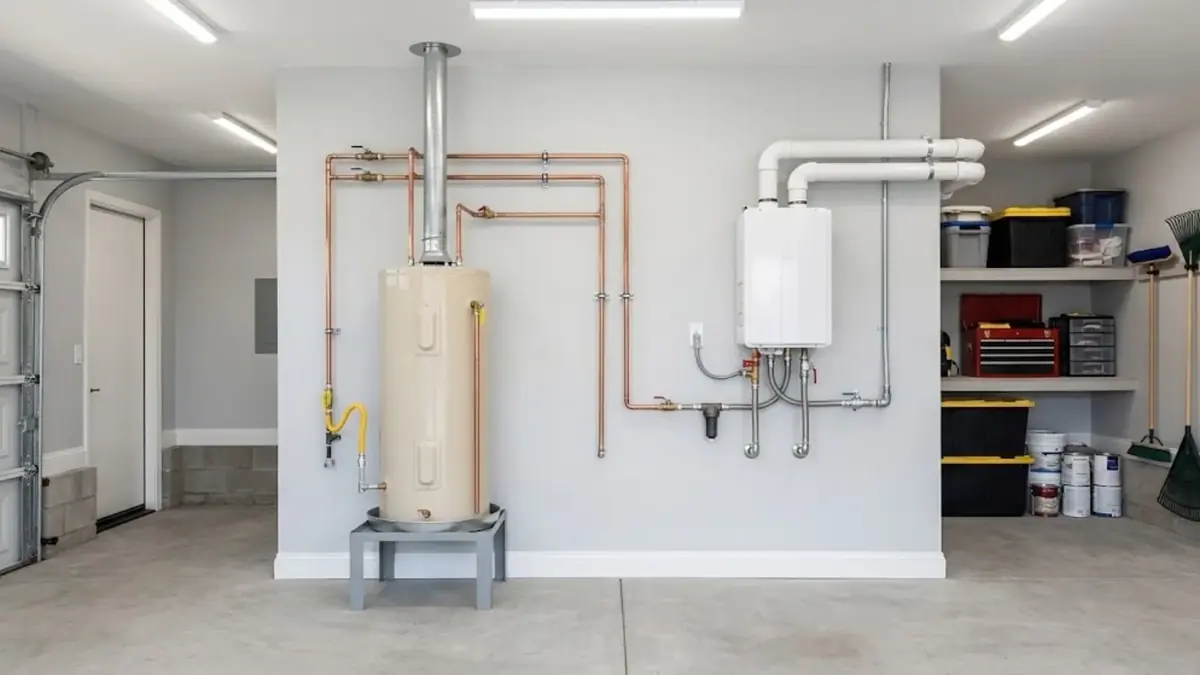
Price is the unit plus the work around it
A quote has two halves. The first is the heater, which ranges from a basic tank to a heat pump or tankless model. The second is everything needed to put it in safely: venting, gas or electrical connections, strapping, a drain pan, an expansion tank, a permit if required and the haul-away of the old unit.
Two quotes that look far apart often differ in the second half, not the first. One includes a new vent and strapping, the other assumes the old vent will do. Asking each plumber to list what is included makes the comparison fair.
What a complete water heater quote should list
| Line item | What it covers | What changes the price |
|---|---|---|
| The heater | Tank, tankless or heat pump unit | Type, capacity, efficiency, brand |
| Venting | Exhaust path for a gas unit | New pipe, length, termination |
| Gas or electrical | Line, valve, circuit or connector | Size of line, distance, new circuit |
| Expansion tank | Absorbs pressure in a closed system | Whether the system needs one |
| Strapping | Holds the unit against earthquake motion | Unit size and wall construction |
| Drain pan and relief line | Leak protection and safety discharge | Location and drain access |
| Permit and inspection | City paperwork where required | Local fees and scheduling |
| Haul-away | Removal of the old unit | Size and access |
How the type of heater changes the bill
The largest single swing comes from the type of unit you choose. The right one depends on your household and your budget, not on what is cheapest to buy.
Lower upfront, higher running cost
- Standard tank, gas or electric
- Fits most existing closets and garages
- Simple to repair later
- Shorter service life than tankless
Higher upfront, lower running cost
- Tankless and heat pump models
- May need larger gas lines, new venting or a new circuit
- Save energy over time
- Need periodic maintenance such as flushing
If you are weighing on-demand units, the page on tankless water heater service explains the flushing and venting that come with them.
The costs people do not expect
Three items surprise homeowners most often. The first is venting. An old vent that is rusted, flat or undersized has to be replaced, and a gas unit cannot be installed safely without a sound one. The second is the gas line. A tankless gas unit draws a lot of fuel at once, and the existing line may be too small.
The third is the gap between the new unit and the old one. A larger tank may not fit the old closet. A different brand may have connections in different places. A plumber who looks at the space before quoting spares you a change order on installation day.
How to compare two quotes
A short list of questions puts two quotes on equal footing.
- What is the exact model and capacity? Ask for the brand, model number and gallons or flow rate.
- Is venting included? Ask whether the existing vent is being reused or replaced.
- Are strapping and the expansion tank included? Both are common line items, and both should be named.
- Who pulls the permit? If one is required, ask who handles it and when the inspection happens.
- What is the warranty? Ask what the manufacturer covers and what the plumber covers on labor.
What the City of Dana Point and the state say
California Health and Safety Code section 19211 requires new and replacement water heaters to be braced, anchored or strapped against earthquake motion. The code applies to units up to 120 gallons that have a pre-engineered strapping kit available, so strapping belongs on every Dana Point quote.
Permits are a local question. The City of Dana Point's Building and Safety Division says permits are generally required for almost all construction, and its homeowner page does not address water heaters specifically. The division's main number is (949) 248-3564, and it can tell you whether a replacement needs a permit. Contractors working in the city must hold a valid California contractor's license in good standing.
When repairing the old heater is the cheaper path
A heater under about eight years old with one failed part is often worth repairing. A heater past ten or twelve years old that is rusting or leaking from the tank is at the end of its life, and putting money into it is borrowing against the next failure.
The label on the side of the tank carries a serial number that encodes the manufacture date. A plumber can read it in seconds. If you are not sure which side of the line you are on, water heater repair explains how the diagnosis works before anyone suggests a replacement.
Safety steps for a heater that fails
- Close the cold water supply to the heater. The valve is on top.
- Turn off the gas or power. Use the heater's switch or breaker.
- Smell gas? Leave first. Call SoCalGas at 1-800-427-2200 or 911.
- Keep clear of a hot drain. Water can be scalding.
Common Questions
The type of unit, followed by the venting and gas or electrical work. A tank unit that fits the old space costs far less to install than a tankless unit that needs a new vent and a larger gas line.
Ask the Building and Safety Division at (949) 248-3564. Its page does not address water heaters specifically, and a licensed contractor can obtain any permit that is required.
It should be on the quote. California Health and Safety Code section 19211 requires new and replacement water heaters to be braced, anchored or strapped.
Often, when the unit is in stock and the schedule allows. A failed tank is a priority. Ask when you call.
The cost factors are the same. The permit office is different. See our San Clemente page for who to call there.
Need an answer for your own address? Call (949) 325-3122