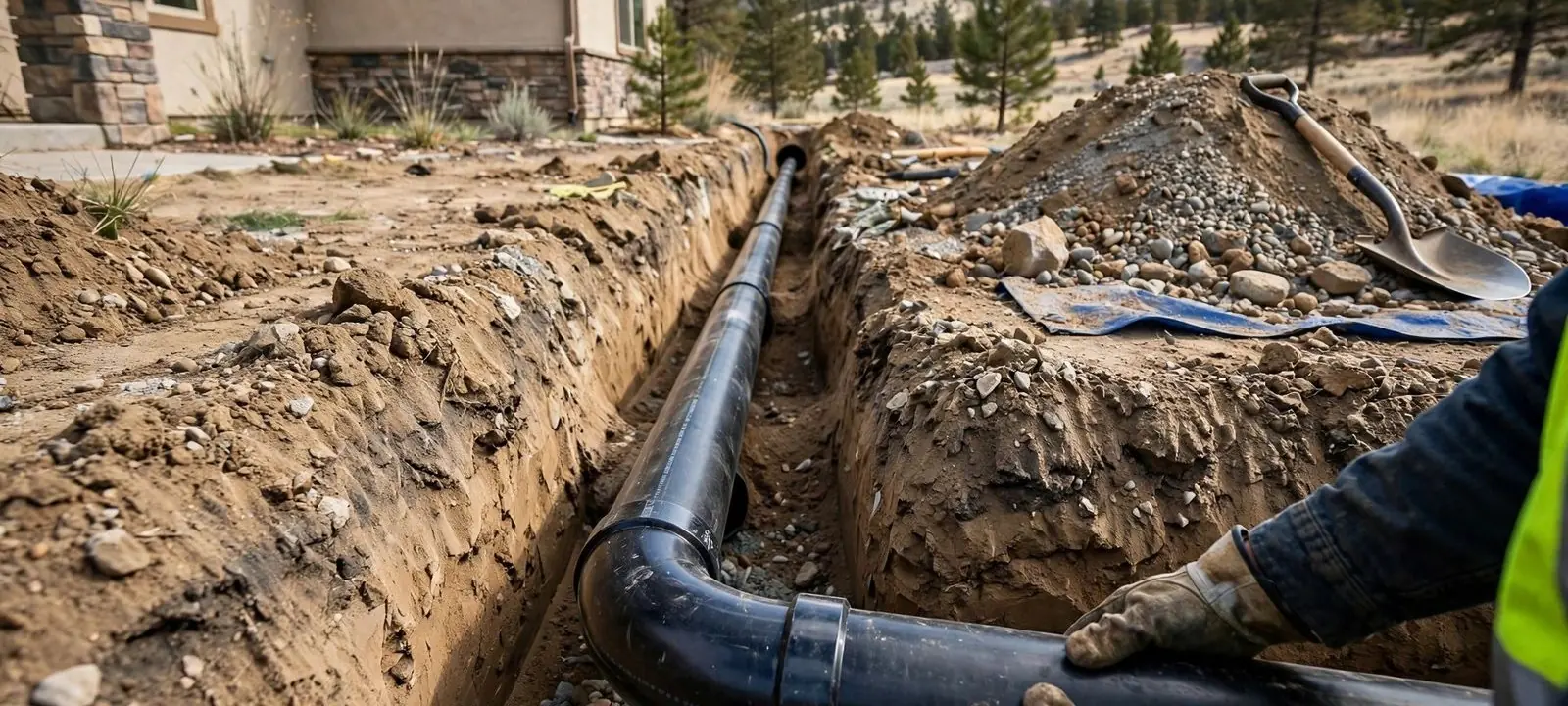
When a failed sewer line becomes an emergency
A line that is leaking or partially collapsed may only cause slow drains for weeks. It becomes an emergency the day it fully blocks, or the day a leak undermines soil under a slab, driveway or hillside.
- Sewage backs up and a cable does not hold. If the line clears and fails again within days, the pipe itself is the problem.
- A sunken patch above the line. Soil washed into a broken pipe leaves a void that settles.
- Sewer smell with no visible backup. Gas escaping from a crack can reach the yard or crawlspace before any water appears.
- Water pooling in the yard with no rain or irrigation. Wet ground over the line can mean a leaking joint or a break.
What the camera usually finds
A camera run shows the pipe from the inside and records distance, so the repair target is exact. Common findings are a single crack, an offset joint where two sections have shifted, a belly that holds water, root masses entering at joints and a complete collapse.
A localized crack with root intrusion is one of the most common repair requests. If the rest of the line is sound, a spot repair at that location is often the sensible choice, and the plumber should show you the footage so you can see why.
Dig, line or replace?
Three approaches handle most failed sewer lines. The right one depends on the pipe, the length of damage and what is on top of the line.
Trenchless lining
- A resin-coated liner is pulled into the pipe and cured in place
- Minimal digging, which helps with driveways and landscaping
- Works best on pipes that are still round and continuous
- A camera confirms the pipe is a candidate
Open-trench spot repair or replacement
- Replaces a broken section directly
- Needed where a pipe has collapsed or sagged badly
- More disruption to yard and surface
- Often the more durable fix for a damaged section
A line that is blocked but not broken may only need sewer line cleaning or hydro jetting. A camera look is how you know which side you are on.
Older homes, older pipe materials
Capistrano Beach started building out in 1925, and Lantern Village holds many of Dana Point's oldest houses. Sewer pipe from that period can be clay, cast iron or fiber. Each fails differently. Clay cracks at joints, cast iron rusts from the inside out and fiber can soften and deform.
If you are repairing a cast iron section, you will often hear about cast iron pipe repair, which usually means cutting out the corroded stretch and replacing it with modern pipe, or lining it where the pipe is otherwise sound. Ask the plumber which they recommend and why.
Septic tanks are uncommon in Dana Point because South Coast Water District provides wastewater service, but a property that predates the sewer or sits outside it can have one. Say so on the call, and the dispatcher will tell you whether it is a job we can send help for.
Questions to ask before approving any repair
Sewer repair is one of the larger plumbing bills a homeowner faces, and a second opinion is reasonable. These questions keep the conversation honest.
- What did the camera show? Ask to see the footage and the distance measurement.
- Is a spot repair enough? A single crack does not always need a whole line replacement.
- Does the work need a permit? Dana Point's Building and Safety Division issues plumbing permits and inspections. Ask the plumber whether the job needs one and who pulls it.
- What happens to the surface? Concrete, landscaping and irrigation lines on top of the repair are part of the plan, not an afterthought.
- What is the price before work starts? A clear price in writing is the minimum.
What affects the price of sewer line repair
The range for sewer repair is wide because no two lines are alike. A short spot repair in an open yard costs far less than a long replacement under a driveway.
Insurance may cover resulting damage but typically not the cost of repairing a worn pipe. Ask your insurer before the work begins.
What to do before the plumber arrives
- Stop using every fixture. Water has nowhere to go.
- Keep people and pets out. Sewage carries bacteria.
- Do not run a dishwasher or washer. That adds to the backup.
- Wear gloves and wash up. If you touch backed-up water.
Common Questions
Yes. The 24/7 line takes calls any hour. For a backup that is putting sewage in the house, the first step is stopping the backup, which can happen tonight. The repair itself is then planned once a camera has shown what failed.
A line that backs up again soon after a cleaning, brings up soil on the cable or shows a sunken patch above it usually needs a repair. A camera inspection confirms it.
It is a way of repairing a pipe from the inside, typically by pulling in a resin liner or replacing the pipe with minimal digging. It works best when the old pipe is still continuous. A camera look decides whether your line qualifies.
Permit rules vary, so ask the Dana Point Building and Safety Division at (949) 248-3564. Their page says permits are required for almost all construction, and a licensed contractor can obtain one.
South Coast Water District maintains the public mains. The line from your house to the connection is generally the owner's, but where that line ends differs by property. Ask the district before paying for work.
Yes. Ask for the camera footage, the proposed scope and the price in writing before approving. That is standard for property managers and is useful for insurance and tenant records.
Need an answer for your own address? Call (949) 325-3122