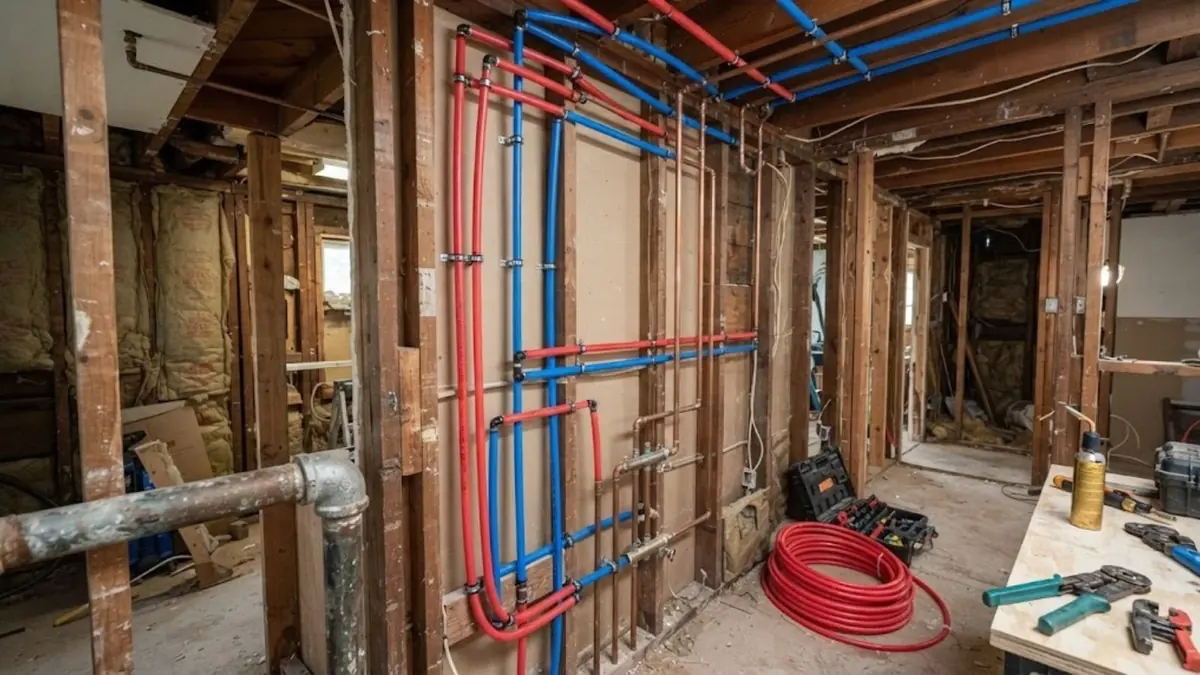
What PEX is and where it is used
PEX is cross-linked polyethylene tubing. It comes in coils and in colors, with red often used for hot lines and blue for cold. It runs from a central manifold to each fixture, or in a branch pattern like rigid pipe.
It is a supply pipe only. Drain, waste and vent lines use different materials. Local code decides where PEX may be used, which is one reason a permit and an inspection are part of most jobs.
How a PEX run goes together
The sequence is the same for a single branch or a whole house.
- Plan the route. Measure each run and mark where lines pass through framing.
- Shut off and drain the water. Close the main valve and open a low faucet.
- Cut the tubing square. Use a PEX cutter, not a saw, so the end seals cleanly.
- Choose the fitting system. Crimp, clamp or expansion fittings each need their own tool.
- Make the connection. Slide the ring on, insert the fitting and tighten with the matching tool.
- Support the pipe. Use clips or hangers at the spacing the manufacturer gives.
- Pressure test. Fill the system and check each joint before closing any wall.
Why the tool matters as much as the pipe
Each PEX fitting system has its own tool, and they do not mix. A crimp ring needs a crimp tool and a gauge to check the result. An expansion fitting needs an expander that fits the tubing size. A wrong tool gives a joint that holds for a day and fails later.
Buying or renting a set of tools for one project is a real cost. That is a common reason homeowners hand the work to a plumber, who already owns the tools and knows the codes.
Permits, licensing and the city office
The City of Dana Point's Building and Safety Division says permits are generally required for almost all construction. A repipe or an addition with new supply lines is the kind of work to ask about before you start. The office is at 33282 Golden Lantern, Suite 209, and its main number is (949) 248-3564.
The city also says contractors working there must hold a valid California contractor's license in good standing. A homeowner doing work on a home they live in should still ask the division what applies, since requirements can differ for owner-builders.
Do it yourself or hire a plumber
A small job and a large one are not the same decision.
A homeowner may handle
- Replacing a short section under a sink
- Swapping a supply line to one fixture
- Work that needs no new walls opened
- Jobs where the city does not require a permit
Call a plumber for
- Whole-house or multi-room repipes
- Anything behind finished walls
- Work tied into the main or the heater
- Jobs that need a permit and inspection
Mistakes that cause PEX leaks
Most PEX leaks trace to a few errors.
- A ragged cut. An angled or crushed end will not seal.
- The wrong ring or tool. Systems are not interchangeable.
- Sunlight exposure. PEX should not sit in direct sun for long.
- Kinks. A bend that is too tight restricts flow and weakens the wall.
- No support. Unsupported runs rattle and wear.
Why the pressure test is not optional
Filling the system and watching a gauge for an agreed time shows weeping joints before drywall hides them. A pressure test costs little compared with opening a finished wall later.
Inspectors often want to see the test. Ask the plumber to schedule the inspection while the walls are still open.
Manifold systems versus branch systems
A manifold system runs one line from a central valve block to each fixture. It gives each fixture its own shutoff, and pressure holds steadier when two fixtures run at once. A branch system uses a main trunk with tees, like rigid pipe, and uses less tubing.
Manifolds cost more in tubing and need a wall space for the block. Branch layouts are simpler in small jobs. A plumber chooses based on how many fixtures and how far they are from the heater.
Heat, sun and chemicals
Keep PEX away from flue pipes, recessed lights and the heater's hot surfaces. Do not store coils in direct sun, and do not let them sit in a hot car. Some solvents and fuels damage the tubing, so keep it clear of fuel storage and paint thinner.
Where PEX meets the water heater, plumbers use a short copper or approved connector. Following the manufacturer's manual keeps the warranty valid.
Water hammer and tubing support
Loose PEX can tap against framing when water starts and stops. Clips every few feet and a bit of slack at turns prevent noise. If you hear a bang after a valve closes, a water hammer arrestor may be needed near that fixture.
What an inspector looks for in a PEX rough-in
An inspector looks for correct fittings, proper support, protection where pipe passes through framing and a passing pressure test. Nail plates protect tubing where it sits close to the face of a stud.
Ask the plumber to leave the walls open until the inspection is done. Closing early can mean cutting the drywall again.
What code and which office apply
PEX is allowed for water supply under the California Plumbing Code, which is based on the Uniform Plumbing Code (UPC), when it is installed to the manufacturer's instructions and the code's support and protection rules. Tubing and fittings should carry a listing mark from an approved testing agency.
Common Questions
For a small job in your own home, sometimes. Whole-house and behind-wall work belongs with a licensed plumber, and permits may apply. Ask Building and Safety at (949) 248-3564.
Yes. Each fitting system has its own tool, and they are not interchangeable.
No. It is a supply pipe. Drains use different materials.
It depends on the house. See our PEX versus copper guide.
Yes. See our San Clemente page. Our service areas page explains how coverage works.
Need an answer for your own address? Call (949) 325-3122