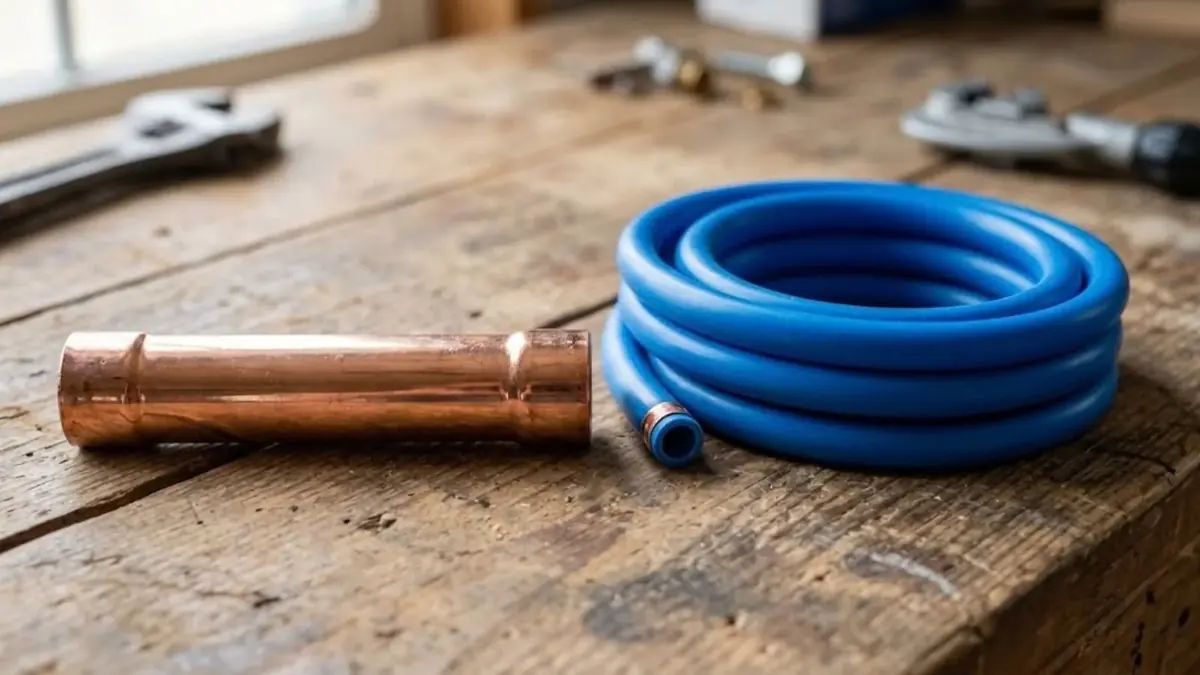
How the two materials compare
| Point | PEX | Copper |
|---|---|---|
| Installation | Flexible, fewer openings in walls | Rigid, more joints and more access needed |
| Corrosion | Does not corrode like metal | Can corrode in aggressive water or coastal air |
| Sunlight | Degrades if left in direct sun | Unaffected |
| Freeze tolerance | Expands more than rigid pipe before splitting | Splits sooner |
| Fire and heat | Plastic, not for flame exposure | Metal, tolerates heat |
| Repair | Fittings are quick to add | Needs soldering with heat |
| Price | Often lower in labor | Material and labor often higher |
Where copper still makes sense
Copper tolerates heat and sunlight, which suits exposed runs and spots near the heater. It has a long track record and it is rigid, so it stays where it is put. Some owners prefer metal and some insurers or buyers do too.
The trade-off is cost and labor. Copper needs more joints and more access, and it can corrode in some water chemistries. Ask the plumber what the pipe in your house shows when it is cut open.
Where PEX earns its place
PEX wins on installation. It bends around framing, so a plumber can run lines through a house with small openings, which means less drywall repair. It does not scale or pit the way metal can, and it is quieter in many installs.
The trade-offs are sunlight and heat. PEX must be kept out of long direct sun and away from flues and the heater's hot surfaces. The first few feet near the water heater are often copper for that reason.
Coastal air, imported water and what that means for pipe
South Coast Water District, which serves Dana Point, imports much of its water through Metropolitan and the Municipal Water District of Orange County and supplements it with local groundwater and recycled water. Water chemistry from a mix like that can change, and the district's annual report at scwd.org/report is the right place to read what is in it.
Salt air is a separate matter and it affects exposed metal. Pipe inside walls is protected from it, but exposed fittings and shutoffs in garages and on exterior walls can corrode. That is one more reason many owners near the water pick PEX for hidden runs and keep metal for visible, heated ones.
Questions that tip the choice
Answer these and the choice is usually clear.
Lean toward PEX
- Walls are finished and you want fewer openings
- Existing pipe is galvanized and failing
- Budget favors lower labor
- Runs are hidden in walls
Lean toward copper
- Many runs are exposed to sun or heat
- You prefer metal throughout
- The plumber advises it for your layout
- Local code or a buyer prefers it
What to ask before you sign a repipe quote
A written answer to each of these avoids surprises.
- What material, and why for my house? The answer should refer to your layout.
- How many wall openings? And who patches them?
- Who pulls the permit? A repipe is permit work in most places.
- What is the plan for water off? Ask how long the house will be without water.
- What warranty applies? Ask for it in writing.
If you still have galvanized or polybutylene pipe
Galvanized steel rusts from the inside, narrows and drops pressure. Polybutylene, used in some homes in past decades, is known for failures at fittings. If a house has either, a repipe is a safer path than repeated spot repairs.
Not sure what you have? Photograph the pipe at the main shutoff and under sinks, and call. A plumber can usually tell the material by sight, and may suggest leak detection first if you only suspect a hidden leak.
How long each material is expected to last
Manufacturers publish warranties for both, and they vary by brand, water chemistry and installation quality. Copper has decades of field history. PEX has a shorter record, but it has been in homes long enough to be well understood.
Instead of chasing a number, ask the plumber what warranty comes with the labor and the material, and ask for it in writing. Good installation matters as much as the material.
What a repipe does to your house and your week
A repipe turns water off for part of a day or longer and opens small sections of wall. PEX usually needs fewer and smaller openings. Copper may need more. Ask the plumber to mark where the openings will be and who repairs them.
Plan for a few days of dust and to be without water during working hours. A good plumber sets a schedule and keeps one bathroom usable when possible.
What buyers and inspectors think
Both materials are accepted by code in most places. A buyer's inspector looks for a clean installation, a pressure test and permit records. Keep the permit, the final inspection sign-off and the warranty with your house papers.
Using both materials in one house
Many repipes use both. PEX runs through walls and attic spaces, while copper stubs connect to the heater and to exposed shutoffs. A mixed system keeps each material where it does best, and a plumber joins them with approved transition fittings.
If a quote proposes only one material, ask why. A thoughtful answer tells you the plumber looked at your layout instead of a template.
Common Questions
Neither wins everywhere. PEX installs with fewer openings and does not corrode like metal. Copper tolerates heat and sunlight. Your layout decides.
Little. It mainly affects exposed fittings and shutoffs in garages and on exterior walls.
South Coast Water District says its annual report is at scwd.org/report.
Ask Building and Safety at (949) 248-3564. The city says permits are generally required for almost all construction.
Yes. See our San Clemente page and the service areas page.
Need an answer for your own address? Call (949) 325-3122