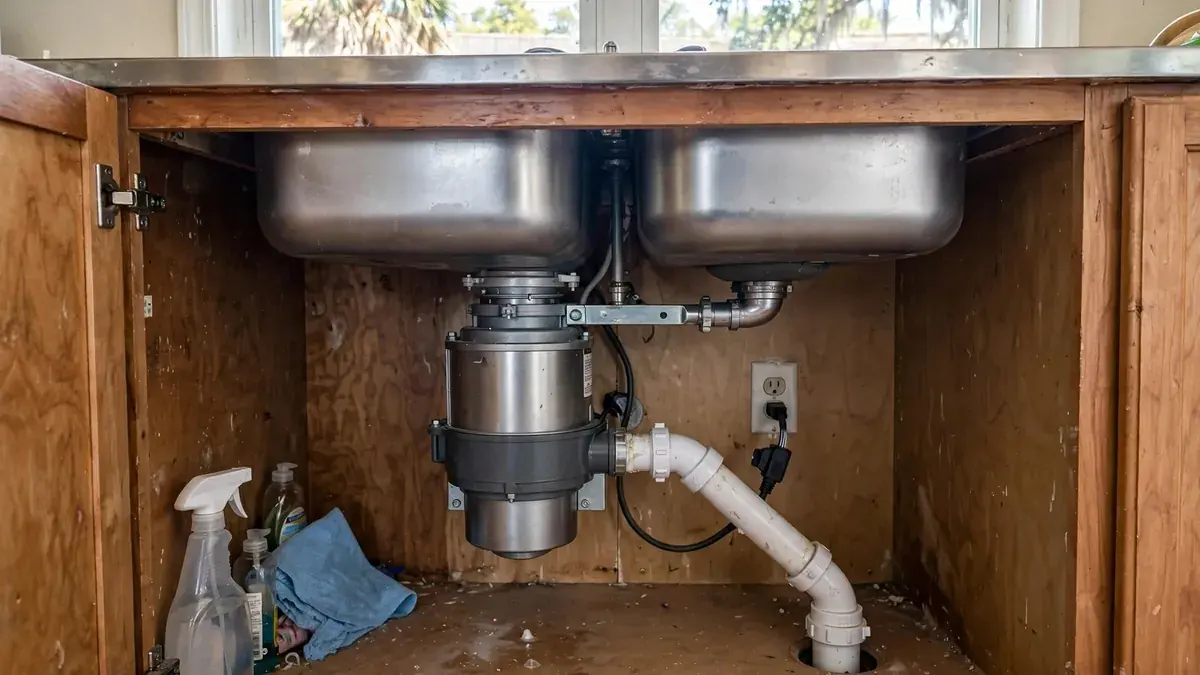
The parts under a double sink
Two basins drain through two openings. One opening holds the disposal. The other has a strainer and a tailpiece that connects to a continuous waste pipe running to the disposal's side or to the trap. A dishwasher hose connects to a nipple on the disposal or to an air gap.
Each connection is a slip joint or a clamp, and each can loosen over time. When you see water, follow it uphill. The wettest point is usually the joint above the lowest drip.
What each part does
| Part | Job | Common failure |
|---|---|---|
| Sink flange and putty | Seals the sink opening | Leaks at the rim |
| Disposal | Grinds food and passes it to the drain | Housing or seal leaks |
| Continuous waste | Joins the second basin to the drain | Loose slip nut |
| Trap | Holds water to block sewer gas | Slip joint or corroded section |
| Dishwasher hose | Carries dishwasher water to the disposal | Hose slips or clamp loosens |
| Air gap | Prevents backflow from the drain to the dishwasher | Clogged or leaking cap |
How to trace a leak under the sink
Dry every joint with a towel, then run water into one basin and watch. Next, run the other basin and then the dishwasher. The one that shows a drip tells you which connection is failing. A paper towel pressed against each joint makes small drips visible.
A leak only when the dishwasher runs points to the dishwasher hose or the disposal inlet. A leak only when one basin is full points to that basin's strainer or tailpiece. A leak all the time, even with no water running, points to a supply line or a shutoff valve and is a different problem.
When the sink is full and the disposal runs
A disposal that hums while the sink stays full has a blockage past it. The line beyond the disposal, or the trap, has clogged with grease or food paste. A cable through the drain clears it. If it keeps coming back, the cause is further down the line, and drain cleaning explains what a plumber does about repeat clogs.
Double sinks with a disposal on one side often clog on the other. The second basin's drain bypasses the disposal and runs through the trap, which fills with grease because nothing grinds it. Run hot water and a drop of dish soap down the second basin after greasy dishes.
Kitchen work and permits in Dana Point
Replacing a disposal is usually a repair. Moving a sink, adding a second sink or remodeling the kitchen is different. The City of Dana Point's Building and Safety page says permits are generally required for almost all construction, including bathroom and kitchen renovations, and that separate plumbing, electrical and mechanical permits are required for work that is otherwise exempt.
If your project goes beyond a swap, call the division at (949) 248-3564 and ask. A licensed contractor can obtain the permit.
The dishwasher connection and the air gap
A dishwasher drains through a hose that connects to a port on the side of the disposal. Before the hose is attached, the port has a knockout plug that must be removed, and a missed plug is a classic cause of a dishwasher that will not drain after a new disposal goes in. If the dishwasher fills with dirty water after a disposal swap, check that plug first.
Some kitchens add an air gap, a small fitting on the sink deck that breaks any path for dirty water to flow back into the dishwasher. If the air gap cap spits water when the dishwasher runs, the line beyond it is partly clogged, and a short cable through the drain usually clears it.
Mistakes that cause the same leak twice
Most repeat leaks come from a short list of installation habits. Knowing them helps you judge a repair, whoever does it.
- Over-tightened plastic nuts. Slip nuts need hand tightness plus a small turn. Cranking them cracks the thread and leaks later.
- A missing or flattened washer. The tapered washer inside each slip joint does the sealing. A joint without one weeps.
- Old putty under the flange. Fresh plumber's putty under the sink flange keeps the rim dry. Dried putty cracks and leaks.
- A trap that does not line up. Forcing a misaligned trap into place stresses the joints and loosens them within weeks.
- An unsupported disposal. The mounting ring holds the unit's weight. A loose ring lets it sag and pulls every connection apart.
Repair the disposal or replace it
A disposal is an appliance with a limited life.
Repair
- A jam that clears
- A loose connection
- A newer unit with a failed seal
- A good model you want to keep
Replace
- The housing leaks
- The motor is burnt out
- The unit is over ten years old
- It jams over and over
If a new faucet is part of the job, faucet repair and replacement covers how the two jobs fit together.
What code and which office apply
A double-sink drain with a disposal is built to the California Plumbing Code, which is based on the Uniform Plumbing Code (UPC), including the trap, the vent and the air gap or high loop on the dishwasher line. According to the code, each fixture needs a trap, so ask the plumber how the two bowls are joined.
Safety steps before you work on a disposal
- Turn off power at the breaker. A wall switch alone is not enough.
- Never put a hand in the unit. Use tongs or pliers to remove an item.
- Shut off the water. Close the valves under the sink.
- Do not mix drain chemicals. Fumes and splashes are a hazard.
Common Questions
Usually yes. Most disposals install under one basin, and the other basin drains through a tailpiece and a continuous waste. The plumber chooses based on the trap and the dishwasher connection.
A hose that slipped off the disposal inlet is the most common cause. Reconnecting it with a clamp usually fixes it.
Grease and oil, large amounts of coffee grounds, fibrous scraps, bones and pits. Run cold water while grinding.
Often. Older homes in Capistrano Beach and Lantern Village may have long kitchen drain runs to the main. See our service areas page for how we cover the area.
Switch it off at the wall, press the reset button on the bottom and try again. If it still hums, a plumber can clear the jam or advise on replacement.
Need an answer for your own address? Call (949) 325-3122