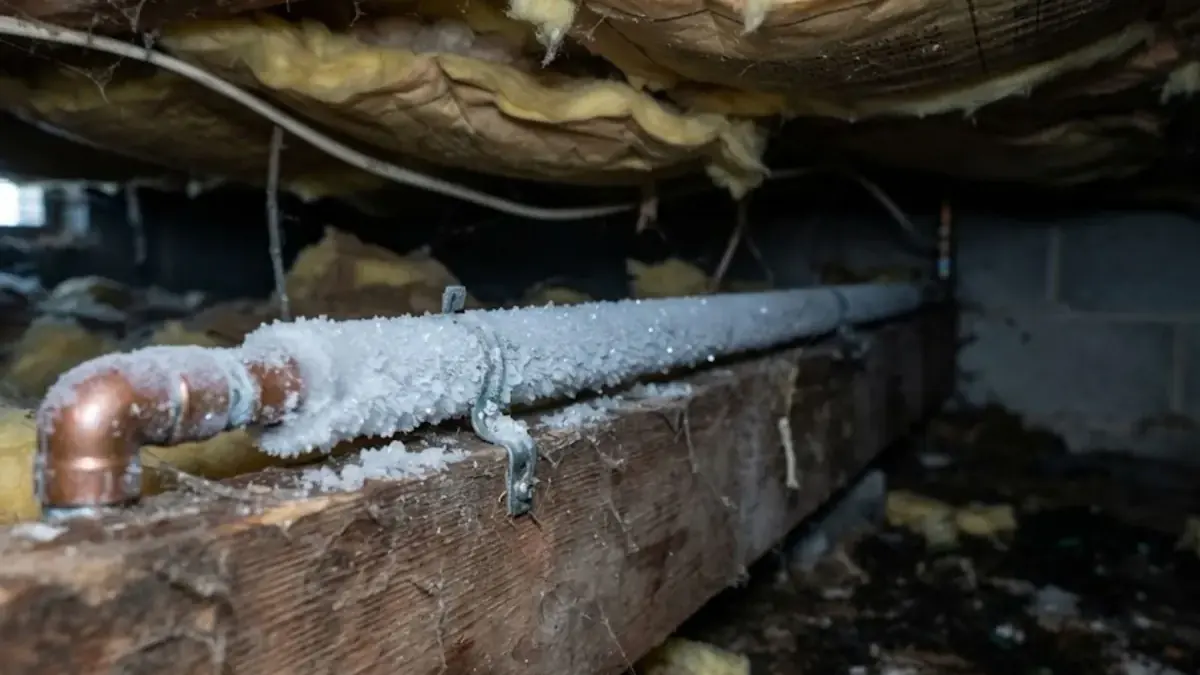
Why tankless units can freeze and tank units rarely do
A tank heater holds dozens of gallons of warm water, and a burner keeps that water warm. A tankless unit holds only a small amount of water in a heat exchanger, and the water sits still when no one is using it. Still water in a small passage can freeze faster than a tank of warm water.
Most modern tankless units have built-in freeze protection. Small heaters inside the unit switch on when the temperature drops, and they work only while the unit has power. A power outage in a cold spell is what turns protection off.
Four setups that are more exposed
Look at where your unit sits.
Outdoor wall mounts
An exterior unit faces the weather directly and depends on its built-in heaters.
Garages with air gaps
A garage door that does not seal lets cold air pool around the unit.
Exposed pipe runs
Short stubs of pipe outside the unit can freeze before the unit does.
Vent terminations
A vent pipe can carry cold air back into the unit if the cap is poorly placed.
Freeze protection that works, and what defeats it
Built-in heaters protect the heat exchanger down to a temperature the manufacturer lists in the manual. They do not protect the pipes outside the unit. Pipe insulation, heat tape rated for the pipe and a sheltered location help the parts the unit cannot protect.
Protection depends on power. A unit on a switched circuit, a tripped breaker or a loose plug has no protection at all. Check that the unit stays powered, and leave the gas and water valves open unless a plumber advises a seasonal shutdown.
What a cold snap means on the Orange County coast
Hard freezes are uncommon in Dana Point, so most owners never see a freeze failure. That can lead to a different problem: a unit installed without freeze thinking, in an exposed spot, with no insulation on the stubs. The first cold night in years can then catch it.
If you live on a higher street away from the water, or your unit sits on a north wall or in an open garage, treat a forecast near freezing as a reason to check it. The City of Dana Point's Building and Safety Division, at (949) 248-3564, can say what permits apply if you decide to move the unit.
A short checklist
On a night with a freeze forecast, do these in order.
- Confirm power. The unit's display should be on and the breaker closed.
- Open the gas and water valves. The unit and its protection need both.
- Let a faucet drip. A slow drip keeps water moving in the line.
- Cover exposed stubs. Wrap them with insulation made for pipe.
- Know the main shutoff. If a pipe splits, close it at once and call.
Signs of freeze damage and what to do
Damage often shows only after the thaw.
Signs
- Water dripping from the unit's case
- No hot water or low flow
- An error code on the display
- A bulge or crack on a pipe
What to do
- Close the water valve at once
- Turn the unit off at the switch
- Do not restart it
- Call a plumber to inspect before using it
A burst section behind a wall is a burst pipe case. Call the 24/7 line.
Ways to make an exposed unit safer for good
If the unit hangs in an exposed spot, a plumber can add insulation, a protective cover or a short relocation. A unit moved a few feet into a sheltered corner may stay protected without extra equipment.
When a new tankless unit is being planned, choose the location with freezing in mind as well as venting and gas. Ask the installer how the model's protection works and what temperature it covers. A good installer answers in specifics.
Condensing units and the drain line
High-efficiency tankless units make acidic condensate that drains through a small line. That line can freeze in the open and back water up into the unit. If your unit is a condensing model, check that the condensate line is short, sloped and not exposed to cold air.
A blocked condensate line often shows up as an error code, not as a leak. If the code appears on a cold morning, that line is the first place to look.
If you will be away from home
A house left empty is the worst case for any pipe, because no one notices a problem for days. If a freeze forecast lands while you are away, ask a neighbor to check the unit, or ask a plumber about a seasonal drain-down.
Leave power on to the unit unless a plumber says otherwise, since the built-in protection needs it. Know where the main valve is, and tell the neighbor.
What code and which office apply
A tankless unit's freeze protection and its minimum operating temperature are set by the manufacturer, and the manual is the standard to follow. Installation follows the California Plumbing Code, which is based on the Uniform Plumbing Code (UPC).
Common Questions
It can, but it is rare. Freezing needs sustained cold, which the coast seldom sees. Exposed outdoor units and open garages carry the most risk.
Only while the unit has power. A tripped breaker or an outage in a cold spell removes the protection.
Not usually on the coast. If you plan to be away in a cold forecast, ask a plumber whether a drain-down makes sense for your model.
Turn it off, close the water valve and call. Do not restart it until a plumber checks for cracks.
Yes. See our San Clemente page, and our service areas page for how coverage works.
Need an answer for your own address? Call (949) 325-3122