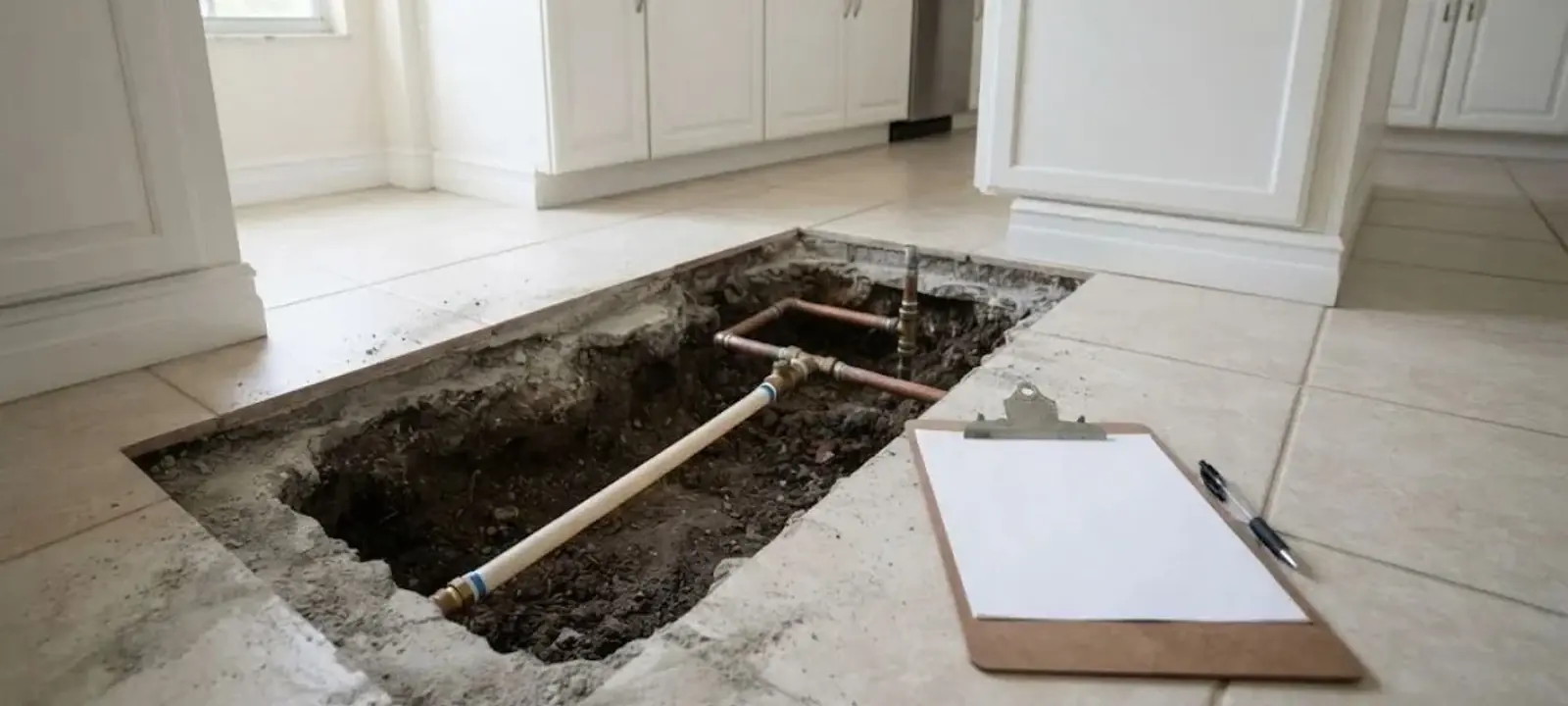
Signs of a slab leak you can check yourself
Slab leaks hide, but they leave a pattern. Check these before the plumber arrives.
- A warm spot on the floor. A leaking hot water line heats the concrete above it. Barefoot, you can often feel it.
- Water appearing at a wall base or under flooring. Moisture that rises through a slab lifts baseboards, buckles wood and stains carpet.
- The sound of running water in a quiet house. A hiss or trickle with every fixture off is a strong clue.
- A meter that moves with the main valve open and all water off. The standard test, covered under leak detection.
- Unexplained mold or a musty smell at floor level. Constant moisture from below feeds both.
When a slab leak is an emergency
A slab leak is urgent when water is coming up into the living space, because wet flooring and drywall begin to fail within a day or two. It is also urgent when the leak is on a hot water line, since that can warm the slab and raise the bill quickly.
While you wait for the plumber, shut off the main valve, open a faucet at the lowest point to relieve pressure, move furniture and rugs off the wet area and photograph the damage for your insurer. If the water heater is nearby, turn it off to protect the tank and the elements.
Spot repair, reroute or repipe?
Once the leak is located, there are usually three ways forward. The plumber should explain which fits and why.
Break the slab and repair
- Cuts a hole in the concrete directly over the leak
- Fixes the pipe where it failed
- Makes sense for a single isolated leak on otherwise sound pipe
- Leaves a patch in the floor that needs finishing
Reroute the line
- Abandons the failed pipe and runs a new one through walls or attic
- Avoids opening the slab
- Makes sense when the pipe has failed in several places
- May need access to finished walls and ceilings
If the line keeps failing in different places, the sensible fix may be repiping the whole house, which replaces the problem instead of chasing it.
What typically causes under-slab leaks
Pipes under a slab fail for a few repeatable reasons.
Corrosion
Copper in some soils and water conditions thins over decades and develops pinholes.
Abrasion
Pipes rub against concrete or gravel as the house heats and cools, wearing through the wall.
Soil movement
Ground shifts stress joints and fittings below the slab.
Poor original installation
Kinks, tight bends and stressed joints fail earlier than clean runs.
Slab homes and coastal soil in Dana Point
Not every Dana Point home is built on a slab. Many older houses in Capistrano Beach and Lantern Village were built on raised foundations, and some newer homes were built on slabs. Check your own house, or ask the dispatcher, before assuming a slab leak is the problem.
For homes that are on a slab, the coastal setting matters. Soil movement near bluffs, and corrosion in pipes near salty ground, can both stress buried supply lines. Dana Point's Building and Safety Division handles plumbing permits and inspections, and a larger reroute or repipe may need one, so ask the plumber who pulls it. You can reach the division at (949) 248-3564.
What affects the price of slab leak repair
Slab leaks cost more than most plumbing repairs because of the concrete and the finish work. A clear price comes before any slab is cut.
Insurance often covers the damage a slab leak causes more readily than the cost of the pipe itself. Photograph the damage before anything is moved.
What to do before the plumber arrives
- Close the main valve. A slab leak runs under pressure.
- Check the floors. Warm spots and damp flooring point to the line.
- Move valuables off the floor. Water travels under flooring.
- Do not drill the slab yourself. Pipes and cables are in there.
Common Questions
Yes. The 24/7 line is open at all hours. If water is coming up into the home, the plumber's first job is to stop the water, and the repair is planned after the leak has been located.
The plumber uses acoustic listening, thermal imaging and pressure testing to narrow the location, then confirms it before any concrete is cut.
If the floor is concrete under your flooring and there is no crawlspace, it is probably on a slab. If you can see a crawlspace access panel or a raised floor, it is probably not. Tell the dispatcher what you know.
Not always. A single leak on an otherwise sound line may just need a spot repair. If several leaks have shown up in a short time, a repipe may be cheaper than repeated repairs.
Usually yes, with the main valve shut off between uses. Run water only when you need it until the leak is fixed.
Call the line and give the unit address. Ask for written findings, photos and the scope of repair, which help with insurance and tenant records.
Need an answer for your own address? Call (949) 325-3122