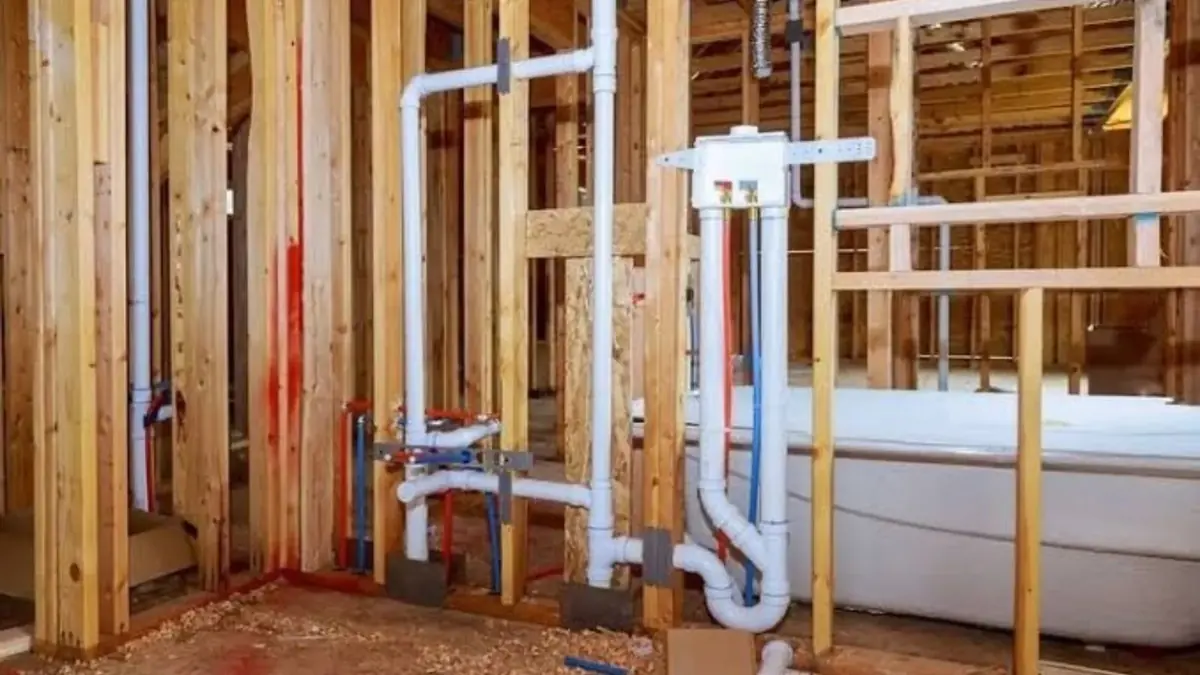
The order of work in a bathroom plumbing job
Plumbing happens in two main stages with an inspection in between.
- Layout. Fixtures are placed and drains and vents are planned.
- Rough-in. Supply and drain lines go into the open walls and floor.
- Inspection. The city checks the rough-in before walls close.
- Walls and tile. Other trades finish the surfaces.
- Trim-out. The plumber sets the toilet, faucets, shower valve trim and vanity.
- Final test. Every fixture is run and checked for leaks.
Why moving a fixture changes the price
A toilet needs a large drain and a vent, and it sits where the floor framing and the main stack allow. Moving it a few feet can mean cutting a joist or running a new drain. A vanity or a shower can often move with less work because their lines are smaller.
If a design plan moves the toilet, ask the plumber to confirm the drain route before you order tile. It is cheaper to adjust a drawing than a floor.
Four choices to settle before rough-in
Changing these after walls close costs far more.
Shower valve type
Valve and trim must match, and the valve is set in the wall.
Fixture models
Rough-in dimensions come from the exact toilet, vanity and tub.
Water heater capacity
A larger shower or a soaking tub may need more hot water.
Access panels
A panel behind a tub valve saves tearing tile later.
Permits, bluff lots and the licensing rule
The City of Dana Point's Building and Safety Division states that permits are generally required for almost all construction, including bathroom and kitchen renovations. The office is at 33282 Golden Lantern, Suite 209, and its main number is (949) 248-3564. Inspections are scheduled through (949) 248-3590.
The division also says bluff-top lots may have additional requirements, and that contractors working in the city must hold a valid California contractor's license in good standing. Ask the plumber who pulls the permit and when the rough-in inspection will happen, and have both written on the quote.
Keeping the plumbing where it is versus moving it
Both approaches are valid. They carry different costs.
Keep fixtures in place
- Lower cost
- Faster schedule
- Less risk of surprises
- Best for a refresh
Move fixtures
- Opens up layout options
- May need new drains and vents
- Adds inspection steps
- Best for a full remodel
Supply sizing for multiple fixtures
A bathroom with a rain head, body sprays and a soaking tub can draw more water than the supply line was sized for. If you plan several outlets, tell the plumber, who can size the line and check the water heater.
Low pressure in an older house can come from old supply pipe inside the walls. If that is the case, a remodel is a good time to talk about repiping the bathroom branch while the walls are open.
Final checks before you accept the work
Run every fixture. Check under the vanity, around the toilet base and at the shower valve for drips. Run the shower for several minutes and watch the ceiling below, if there is one, for stains. Flush the toilet several times and watch for slow draining.
Write down any problem the same day and send it to the plumber. Small drips are easy to fix right away and hard to trace weeks later.
Shower valves, drains and pans
A shower needs a valve that blends hot and cold, a drain with the right slope and a waterproof pan under the tile. Mistakes here cause leaks that show up months later as stains in a room below or soft floors.
Ask who tests the pan before tile goes down. A simple flood test, held for a set time, shows a leak before it is hidden.
Vents, traps and why a drain gurgles
Every fixture drain needs a trap and a vent so the water seals out sewer gas and flows freely. A drain that gurgles often points to a vent problem. In a remodel, a plumber checks that each new fixture has a proper vent path.
If the bathroom is on a second floor, the drain and the vent pass through the floor below. Ask where the new lines will run and whether any ceiling must be opened.
Planning for the long run
If you plan to stay in the house for decades, consider blocking in the walls for future grab bars and choosing a valve that is easy to reach. Adding blocking costs little while walls are open and is very hard to add later.
Hot water wait times in a new bathroom
A bathroom far from the water heater waits longer for hot water and wastes water while it runs. A recirculating loop or a shorter pipe run helps. Raise this at the planning stage, because the best fix is a route that is short and insulated.
If the heater is old, a bathroom project is a good moment to check its size and age, since a new shower can double the daily demand.
What code and which office apply
Bathroom plumbing follows the California Plumbing Code, which is based on the Uniform Plumbing Code (UPC). According to the City of Dana Point, permits are generally required for bathroom and kitchen renovations, and the rough-in inspection must pass before walls are closed.
Common Questions
The City says permits are generally required for almost all construction, including bathroom and kitchen renovations. Ask Building and Safety at (949) 248-3564.
Rough-in is the supply and drain piping installed in open walls and floors before they are closed. It is inspected before surfaces go up.
Often, but it depends on the floor framing and drain route. Ask a plumber before ordering tile.
It depends on scope. A fixture swap is a day. A full relocation with new lines takes longer and includes an inspection wait.
Yes. See our San Clemente page and the service areas page.
Need an answer for your own address? Call (949) 325-3122